NANROBOT Review: D6+ MAX, N6 72V & LS7+ Compared
-
October 08 , 2026
-
38
Introduction
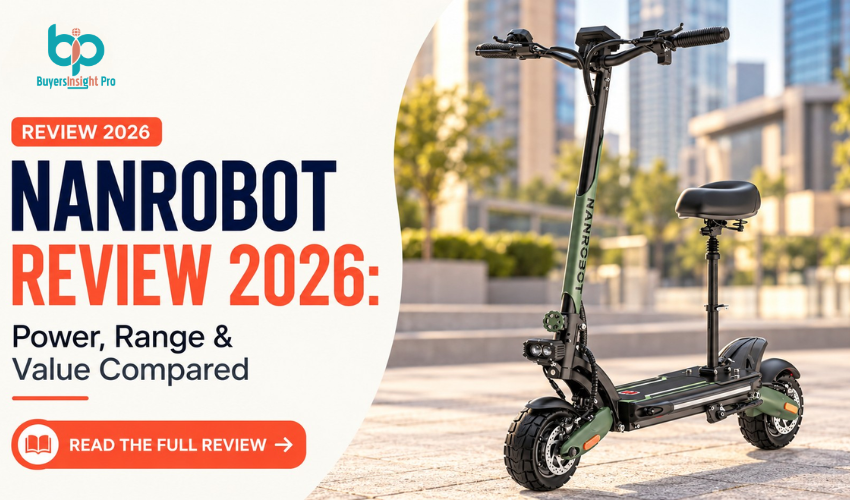
A fast electric scooter can look like excellent value until you have to carry it upstairs, replace a damaged component, or discover that its advertised range assumes conditions unlike your daily ride. This NANROBOT review looks beyond headline speed to help you choose a scooter you can realistically own. We compare the older D6+, current D6+ MAX, N6 72V, and LS7+ 72V, including pricing, battery capacity, practical limitations, and customer feedback.
The appeal is clear: NANROBOT offers substantial performance specifications at prices that can undercut some enthusiast alternatives. The uncertainty lies in how those specifications translate into everyday usefulness and dependable ownership.
Review approach: This is a research-based NANROBOT electric scooter review using official product pages, published policies, and external customer feedback. We have not ridden these scooters or independently measured acceleration, braking distance, range, or durability. Information was checked on October 7, 2026.
Check Today's Price
What Is NANROBOT?
NANROBOT sells electric scooters through its official website and dealer channels. Its range includes commuter products as well as substantially more powerful scooters aimed at enthusiasts. The company presents itself as an established performance-focused brand with a decade-long development history. The models covered here occupy the performance end of that range. Their appeal comes from combining substantial batteries, powerful motors, suspension, and hydraulic braking in a standing-scooter format.
They are most relevant to buyers who already understand the compromises of a larger machine. Recreational riding, demanding routes, and ground-floor storage are more compatible with these designs than repeated lifting onto trains or into upstairs apartments. A scooter’s maximum speed also does not establish where it may legally be ridden. Check the rules applying to your location and intended route before purchasing.
NANROBOT Scooter Review: Understanding the Models
NANROBOT D6+ Review: Check Which Version You Are Buying
The older D6+ 2.0 listing advertised a 52V 26.1Ah battery, two 1,000W motors, approximately 40 mph maximum speed, and brake-specific variants. However, the standard D6+ product URL now redirects to the D6+ MAX. That distinction matters when comparing reviews or shopping through another retailer. An older riding video, used listing, and current official product page may describe different scooters. Ask for the exact generation, brake configuration, battery specification, and included accessories. For used purchases, battery condition and parts compatibility can matter more than the original selling price. An attractive older D6+ deal could make sense, but only when the seller identifies the scooter accurately and provides a credible ownership history.
NANROBOT D6+ MAX Review: The Value Starting Point
The current D6+ MAX page displayed $1,399. It lists a 60V 30Ah battery, two 1,500W motors, 10-inch tubeless tires, NUTT hydraulic brakes, and KKE hydraulic suspension. Advertised maximums are 45 mph and 75 miles, with a listed weight of 88.18 lb. My assessment is that this is the logical first comparison for buyers seeking performance without moving immediately into a much heavier premium model. Its equipment creates a convincing paper proposition. The limitation is that nearly 90 lb remains a serious burden. Folding helps with storage dimensions; it does not turn the scooter into something convenient to carry. The D6+ MAX is most attractive when it can stay near ground level and the owner can maintain its tires, brakes, and folding mechanism.
NANROBOT N6 72V Review: More Battery, More Commitment
The N6 72V page displayed $1,749 and identified a July 2026 update with a 72V 33Ah Samsung-cell battery. It advertises 3,000W motor power, 50 mph maximum speed, up to 90 miles of range, and a weight of 103.62 lb. A steering damper is listed as included. The strongest reason to consider it is battery capacity. Using nominal voltage multiplied by amp-hours gives approximately 2,376 Wh, compared with 1,800 Wh for the D6+ MAX. Those are calculated nominal energy estimates, not usable-energy measurements. Still, they provide a more meaningful comparison than voltage alone. The additional weight changes the ownership experience. Moving this scooter through narrow entrances, loading it into a vehicle, or recovering it after a breakdown requires planning.
NANROBOT LS7+ Review: An Enthusiast Purchase
The current LS7+ 72V page displayed $2,299. It lists 6,000W motor power, a 72V 35Ah Samsung-cell battery, four-piston NUTT hydraulic brakes, adjustable hydraulic suspension, and 11-inch tire options. Advertised maximum speed is 74.5 mph; listed weight is 119.05 lb. This is the hardest model to justify for ordinary transportation. Its performance ceiling may appeal to an enthusiast, but it does not automatically improve a short commute. The important question is whether you have a suitable place to use its capabilities, appropriate protective equipment, and experience controlling a powerful standing scooter. Buy it for a clearly defined use case. Choosing it simply because it is the fastest option leaves you carrying the cost and weight of capabilities you may rarely use.
Key Features: What Actually Matters?
Motor Power and Controllable Acceleration
Large motor figures attract attention, but usable power depends on the controller, battery, throttle response, and traction. For everyday ownership, smooth low-speed control matters considerably. A scooter that feels predictable when pulling away or negotiating a tight turn is easier to live with than one whose main attraction is a dramatic full-throttle launch. Avoid comparing nominal and peak power as though they are interchangeable. Where listings do not explain the measurement basis, treat the wattage as a manufacturer specification rather than a standardized performance result.
Battery Capacity and Range Reserve
A larger battery can provide useful flexibility. It may allow a rider to finish a longer route without charging or maintain a more comfortable reserve. However, maximum range is not the distance you should plan to achieve every day. Faster riding, hills, headwinds, heavier loads, low temperatures, and battery aging can reduce available distance. Plan around your complete round trip, including detours. A scooter that can theoretically finish the journey with almost no charge remaining leaves little margin for changing conditions.
Suspension and Tire Selection
Suspension is valuable on uneven pavement, but its presence does not establish ride quality. Adjustment, tire pressure, rider weight, and the road surface influence how the scooter behaves. Tires also deserve a deliberate choice. A tread pattern suited to loose ground may be less appealing for regular paved riding. Tubeless does not mean puncture-proof. Owners still need to inspect tires, maintain pressure, and understand how repairs are handled.
Hydraulic Brakes
Hydraulic braking equipment is encouraging on a heavy performance scooter. The useful benefit is controlled stopping, not the component name itself. Brake condition, rotor alignment, pad wear, grip, and rider technique remain important. No independently measured NANROBOT stopping distances were established for this review. Leave room for the possibility that a new scooter needs adjustment before normal use. A powerful motor cannot compensate for a brake that drags or responds inconsistently.
First Impressions: Packaging, Design and Setup
The scooters’ published images show substantial decks, prominent suspension components, and a purposeful appearance. They look suited to buyers who want visible performance hardware. Without receiving a retail shipment, we cannot assess protective packaging, cosmetic condition, assembly tolerances, or how well a particular unit was inspected before dispatch. For the buyer, arrival inspection should be methodical. Photograph the package, check for damage, verify included components, and inspect the scooter before riding. Follow the current model manual for assembly and adjustments. Pay particular attention to the stem, folding lock, wheel security, tire pressure, and brake function.
Start with a conservative mode in a clear area. Learn the controls and stopping response before increasing speed. If anything feels loose, binds, or behaves unexpectedly, resolve it before continuing. Keep the packaging until you are confident about the scooter and understand the return conditions. On a large purchase, the box is part of your ability to deal with problems.
Performance and Real-World Ownership
Where the Specifications Look Strong
On paper, these scooters offer ample performance headroom for riders whose routes challenge smaller commuter models. The practical advantage is not necessarily riding faster. It can be having reserve capacity for hills, longer journeys, or recreational use. That is an inference from the listed equipment. It should not be mistaken for a measured hill-climbing result, a guarantee for a specific rider, or proof of sustained performance under every load.
Weight Is the Main Everyday Compromise
The listed weights span roughly 88–119 lb across the current models discussed here. That affects more than portability. Consider what happens if you get a puncture several miles from home, need to lift the scooter into a car, or encounter an entrance with steps. A heavier machine can be perfectly manageable when storage and recovery arrangements are suitable. It can become frustrating when those details are overlooked. Before buying, measure your storage space and vehicle opening. Imagine moving the scooter with the battery depleted rather than assuming you will always ride it to its destination.
Range Claims Need Context
The published maximum ranges make these models look capable of lengthy trips. They should be treated as manufacturer claims, not independent route-planning guarantees. Speed consumes energy quickly. It is therefore unwise to assume you can combine the maximum advertised speed with the maximum advertised range. A realistic assessment requires consistent testing conditions: rider weight, route elevation, temperature, speed, tire pressure, and the charge level at the end. Without those details, competing range numbers can give a false sense of precision.
Maintenance Is Part of the Purchase
Budget for consumables and time. Tires, brake pads, and routine adjustments are normal ownership requirements. Before ordering, identify who can repair the exact model locally and whether important replacement parts are available. A nearby workshop may decline unfamiliar scooters or lack the necessary components. This preparation is especially valuable if the scooter will be your main transport. Spare performance capacity does not help when the machine is waiting for a part.
Pricing and Value Analysis
The following US-dollar prices appeared on official product pages when checked. Options, promotions, stock, tax, and delivery arrangements may change.
| Current model | Displayed price | Listed battery | Calculated nominal energy |
| D6+ MAX | $1,399 | 60V 30Ah | 1,800 Wh |
| N6 72V | $1,749 | 72V 33Ah | 2,376 Wh |
| LS7+ 72V | $2,299 | 72V 35Ah | 2,520 Wh |
Source: official product listings. Energy estimates use voltage × amp-hours; they are not independently measured usable capacities.
Which Upgrade Makes Financial Sense?
At these prices, the N6 costs $350 more than the D6+ MAX. Its calculated nominal battery energy is approximately 32% greater, which makes the upgrade worth examining for longer routes. The LS7+ costs another $550, while its calculated nominal battery energy is only about 6% greater than the N6’s. Its case therefore rests more heavily on performance and equipment preferences. This arithmetic does not establish real-world efficiency or battery quality. It does show why “buy the most expensive model for better range” is an oversimplification.
Warranty Coverage Is More Limited Than the Headline
NANROBOT advertises a 12-month limited warranty, but the detailed policy assigns different periods and mileage conditions to components. Examples include six months and a 3,000 km condition for the battery, three months and an 800 km condition for the controller, and 12 months and a 4,000 km condition for the motor. Selected structural components have lifetime coverage, with customer-paid shipping after the normal period. Read the policy for your exact purchase. A headline warranty period is not equivalent to equal coverage across the entire scooter.
Returns Are Not a Riding Trial
The direct-store policy requires authorization, unused condition, original packaging, and complete accessories within its 15-day return window. It also describes a 10% handling fee and shipping costs for applicable returns, while distinguishing damaged or incorrect shipments. At $1,399, 10% alone is $139.90. Freight could add considerably more. That makes choosing the right model before purchase financially important. Dealer policies may differ, so evaluate the seller as carefully as the scooter.
Explore BRAND Collections
NANROBOT Pros and Cons
| Pros | Cons |
| Competitive equipment for the displayed prices | Heavy scooters are difficult to carry |
| Several performance levels to compare | Maximum range is not independently verified here |
| Substantial listed battery capacities | More power can demand greater riding skill |
| Hydraulic braking on the reviewed current models | Maintenance and adjustment remain necessary |
| Published warranty and return policies | Component coverage is shorter than the headline in several cases |
| Parts and dealer channels exist | Customer feedback raises concerns about support consistency |
Who Should Buy NANROBOT?
NANROBOT makes the most sense for an experienced rider who values performance, has convenient storage, and can manage routine maintenance. The D6+ MAX is the strongest starting point for a value-focused shortlist. The N6 deserves consideration when battery capacity matters enough to justify its additional weight. The LS7+ belongs on an enthusiast shortlist where its capabilities serve a specific purpose.
| Buyer profile | Best starting point |
| Performance buyer watching the budget | D6+ MAX |
| Rider prioritizing battery reserve | N6 72V |
| Experienced performance enthusiast | LS7+ 72V |
| Buyer considering a discounted older scooter | Verify the exact D6+ generation |
| Commuter regularly carrying a scooter | Compare lighter models first |
Who Should Avoid NANROBOT?
Avoid these particular performance models if you need to carry a scooter frequently or have limited storage. They are also difficult to recommend as an impulsive first purchase based on speed alone. New riders may find a lower-powered commuter model easier to learn and more convenient. Buyers dependent on immediate local repairs should establish service availability first. If downtime would seriously disrupt your routine, a seller with a nearby workshop may justify a higher price. Finally, skip a model whose capabilities exceed what your intended riding environment permits or requires. Unused performance still adds expense and ownership burden.
NANROBOT Reviews and Trustpilot Feedback
The NANROBOT Trustpilot page retrieved for this review displayed 3.0/5 from 63 reviews. This is a dated snapshot from a small, self-selected sample, not a measured product failure rate. Positive accounts describe enjoyable performance, solid-feeling construction, and helpful assistance. Negative accounts include defective components, delayed parts, and frustrating communication. Some company replies dispute details or describe attempted resolutions.
The practical concern is consistency: different owners report very different support experiences. Individual reviews cannot establish how often a problem occurs. Seller-hosted feedback also needs model checking. The D6+ MAX page includes some comments explicitly discussing the older D6+ 2.0, so its combined review display should not be treated as evidence exclusively about the MAX. Read recent, specific accounts that identify the model and describe the problem, response, and eventual outcome. That is more useful than relying on the average alone.
NANROBOT vs Competitors
| Alternative | Verified point of comparison | Why consider it? |
| Kaabo Mantis King GT | Official page displayed $1,999, 60V 24Ah battery, hydraulic brakes, and 73 lb weight | A lighter performance alternative to compare |
| Kaabo King GT Pro | Official listing advertises up to 62 mph | Another enthusiast-level option |
| Segway Ninebot MAX G2 | Regional official specifications list a 551 Wh battery, suspension, and turn indicators | Compare when commuter suitability matters more than extreme performance |
Competitor figures are manufacturer specifications. Regional versions and current offers vary. The Mantis King GT is particularly relevant to buyers weighing the D6+ MAX or N6. Compare total cost, seller support, weight, tire arrangements, and warranty terms rather than looking only at motor power. The Segway occupies a different category. Its inclusion is deliberate: a commuter-focused scooter may suit your actual routine better even when its specification sheet appears less dramatic. No head-to-head riding test was conducted, so this comparison does not establish superior handling or reliability.
Frequently Asked Questions
1. Is NANROBOT a good scooter brand?
It offers competitive performance specifications, but mixed support feedback and heavy designs make suitability important. Evaluate the exact model and seller rather than relying on the brand name alone.
2. Is the D6+ the same as the D6+ MAX?
No. The older D6+ 2.0 and current MAX have different specifications. The older standard product link now redirects to the MAX, so check the generation carefully.
3. Which NANROBOT offers the best value?
At the checked prices, the D6+ MAX is our starting recommendation for value. That judgment assumes its weight and performance suit the buyer.
4. Is the N6 72V better than the D6+ MAX?
It offers greater listed battery capacity but adds cost and weight. It is preferable only when those differences serve your route and priorities.
5. Is the LS7+ suitable for beginners?
It is a demanding starting point. Its performance and mass make a more manageable scooter worth considering first.
6. Will a NANROBOT achieve its advertised range?
Not necessarily. Maximum range figures are manufacturer claims; speed, terrain, weather, load, and battery condition influence actual distance.
7. What do NANROBOT Trustpilot reviews suggest?
Feedback is mixed. Reviews describe both enjoyable ownership and support problems, so examine recent model-specific accounts and repair options.
8. Can I ride a NANROBOT before returning it?
The direct-store policy requires unused condition. Do not assume it provides a riding trial; confirm the terms with your seller.
9. Does the warranty cover everything for 12 months?
No. The published component schedule includes shorter periods and mileage conditions. Check the battery, controller, and other important parts individually.
10. Is NANROBOT worth buying?
It can be worthwhile for experienced riders with suitable storage and maintenance arrangements. It is less compelling for buyers prioritizing portability or simple ownership.
Final Verdict
NANROBOT offers an attractive combination of advertised equipment and price, especially in the D6+ MAX. The N6 72V provides a credible battery-capacity upgrade, while the LS7+ serves a narrower enthusiast audience. The tradeoffs are substantial weight, uncertain real-world range, uneven owner feedback, and policies that require careful reading. Buyers with riding experience, ground-level storage, and a maintenance plan should consider the brand. Frequent carriers, cautious beginners, and commuters needing immediate local support should compare alternatives.
Final editorial rating: 7/10. NANROBOT earns consideration on value, but the right seller and ownership setup are essential to making that value last.
Shop BRAND Now
Can I write you?
Sign up to get my weekly newsletter.
Trending Stories



Best Seller