A portable power station sounds like a simple purchase until you start comparing the numbers. One model promises 800 watts, another advertises 2,048 watt-hours, and a third boasts enough output to run high-powered appliances. Then there are solar panels, charging times, UPS modes, expansion batteries and warranties. It is easy to spend too much on features you will rarely use—or buy a unit that cannot run the one appliance that matters.
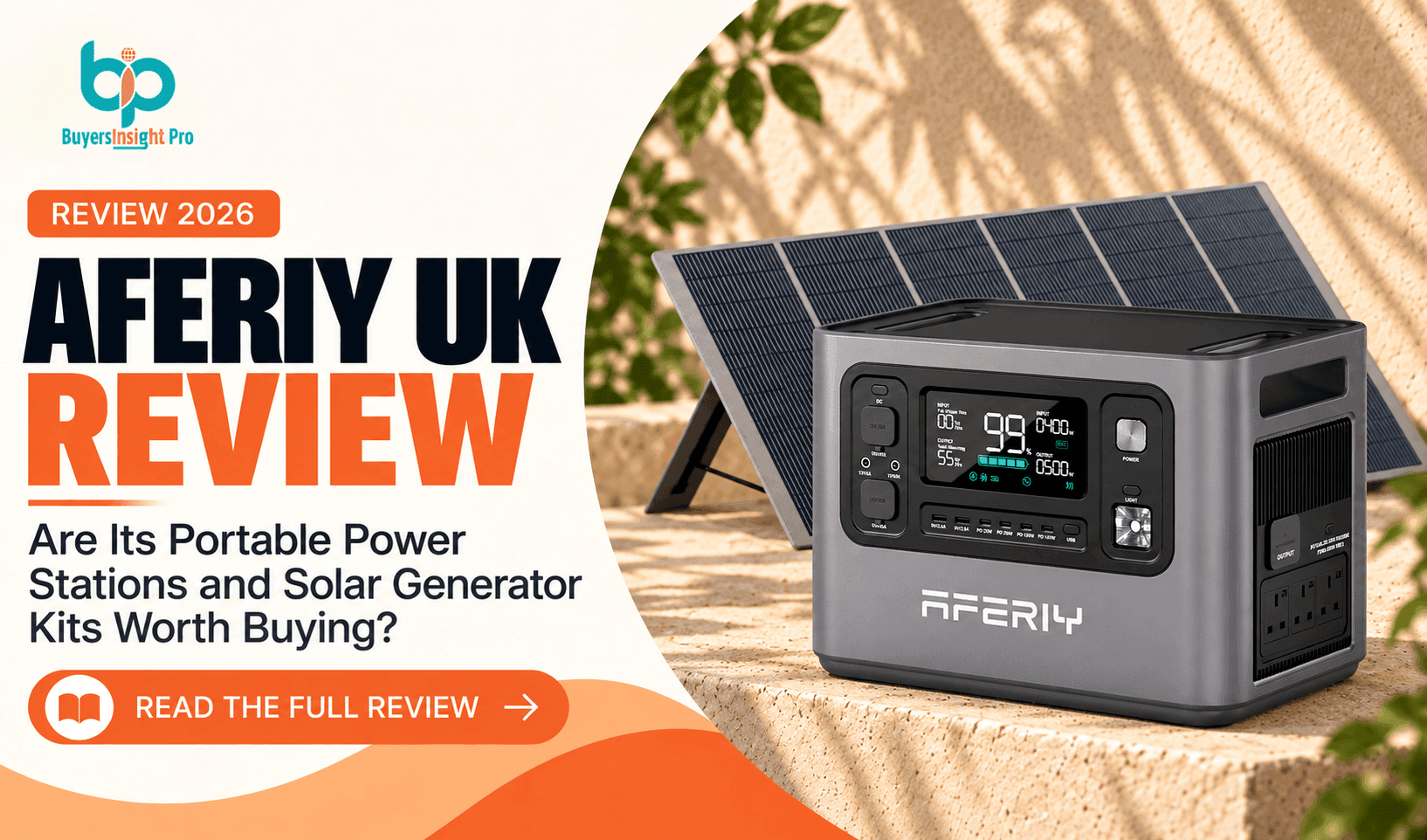
AFERIY UK offers a broad range of lithium iron phosphate (LiFePO4) power stations, solar generator bundles and portable panels. Its lineup covers small weekend-camping batteries, capable midrange stations for campervans and home offices, and larger systems intended for extended backup. On paper, the range is compelling: relatively generous output ratings, multiple charging methods and often substantial discounts from list prices.
But a portable power station is more than a specification sheet. How much electricity can it actually deliver? What happens when clouds interrupt solar charging? Does a quoted seven-year warranty mean seven years of identical coverage? And how do you judge the brand when customer feedback varies between its UK storefront and wider international profile? This AFERIY UK review works through those questions and offers a practical model-by-model buying guide. It is based on published specifications, policies and customer feedback, not claimed hands-on testing.
Start with the appliance you need to power, then compare the wattage and battery capacity of AFERIY’s current UK models.
Explore AFERIY Power Stations →AFERIY UK at a Glance
AFERIY sells portable power stations, solar generator kits, foldable and rigid solar panels, expansion batteries and accessories through its UK website. Its present range includes the compact P040 and P010, Nomad1800 models, P210 and P280 mid-to-large stations, and high-capacity Haven/P310 systems. Most major models use LiFePO4 battery chemistry and pure sine wave AC inverters. Exact connectivity, expansion capability and recharge specifications vary by model and revision.
Quick verdict: AFERIY is worth comparing when you want substantial battery capacity and output for the money, especially for occasional camping, off-grid leisure or planned backup. However, buyers should check availability, the exact product generation, the warranty registration requirements and the unusually restrictive terms for change-of-mind returns. The strongest purchase is not automatically the most powerful station; it is the smallest reliable setup that covers your measured needs.
What Makes AFERIY Different?
AFERIY positions itself as an accessible alternative in a category populated by well-known names such as EcoFlow, Bluetti and Jackery. Its UK catalogue spans several price and power tiers, so a shopper can begin with a 512Wh P010 and move to a 3,840Wh P310 without leaving the same ecosystem. That breadth is convenient when comparing the same brand’s products, though it also means buyers must distinguish older models from newer Haven and Nomad releases.
The brand frequently promotes LiFePO4 batteries, multiple AC and USB outputs, rapid mains charging and solar compatibility. LiFePO4 chemistry is popular in modern portable stations because it generally offers good cycle life and thermal stability. It does not make a device immune to faults, overheating, poor installation or battery ageing, and the claimed number of cycles should always be read alongside the stated retained-capacity threshold.
The UK site lists prices in pounds and offers UK-oriented specifications, including 220–240V or 230V AC outputs on relevant models. That matters because buying an imported station with the wrong voltage, plug or frequency can create problems. Even within a UK listing, confirm the socket layout and appliance compatibility before ordering.
Understanding Watts, Watt-Hours and Real Runtime
The most important distinction is between watts (W) and watt-hours (Wh). Watts describe the rate at which an appliance consumes electricity and the output a station can deliver at a given moment. Watt-hours describe the energy stored in its battery. A 2,048Wh station is not necessarily able to run a 2,400W appliance for an hour; real runtime is reduced by conversion losses, idle consumption and the appliance’s changing load.
A useful planning estimate for AC appliances is battery watt-hours multiplied by roughly 0.75 to 0.85, divided by the average appliance watts. The range is only a planning assumption, not a tested efficiency rating for AFERIY. For example, a 1,024Wh unit supplying a steady 60W load might deliver roughly 12.8 to 14.5 hours under that assumption. A fridge may run intermittently, while a kettle demands a high burst of power, so both average consumption and startup surge matter.
For high-demand appliances, check the continuous inverter rating first. A station rated at 800W cannot normally run a 2,000W kettle, regardless of how much energy is stored. Surge or boost modes are not a substitute for continuous rated output, and some boost modes reduce voltage in ways that certain appliances may not tolerate. Check the appliance label, the manufacturer’s guidance and any startup requirements before connecting it.
AFERIY UK Portable Power Station Comparison
The table uses the core model specifications published by the UK store. Prices are advertised starting points observed in October 2026 and may differ by variant, availability and promotion. Some models are sold out at times, so do not interpret the listing as a live stock guarantee.
| Model | Battery capacity | Rated AC output | Advertised from | Most suitable use |
|---|---|---|---|---|
| P040 | 256Wh | 400W | £189 | Phone, laptop, lights and very light travel |
| P010 | 512Wh | 800W | £279 | Short camping trips and modest emergency power |
| Nomad1800 / P180 | 1,024Wh | 1,800W | £399 | Camping, campervans, home office |
| Nomad1800 Pro | 1,024Wh; expandable on selected configuration | 1,800W | £439 | Flexible travel and expandable backup |
| P210 | 2,048Wh | 2,400W | £629 | Longer backup and higher-load appliances |
| P280 | 2,048Wh | 2,800W | £749 | Higher power demand with same base energy as P210 |
| Haven3000 / P300 | 2,048Wh; expandable | 3,000W | £849 | High-output backup and expansion |
| P310 / Haven3600 | 3,840Wh; expandable | 3,600W | £1,234 | Larger home backup and longer off-grid use |
AFERIY P010 Review: A Sensible Entry-Level Camping Station
The P010 combines a 512Wh battery with 800W rated AC output, making it one of the more approachable AFERIY products for buyers who need more than a basic power bank. The UK site advertises eight outlets, LiFePO4 chemistry, rapid charging and a weight around 6.5kg. At a listed starting price of £279, its appeal lies in a manageable combination of size, output and stored energy.
This is a logical fit for lighting, charging camera batteries, running a laptop and supporting small low-power appliances on a short trip. It is not a substitute for a large home battery. A 512Wh pack has limited endurance when the load rises, and the 800W inverter is below the requirement of many heaters, hair dryers and kettles. The best way to appreciate the P010 is as a portable convenience product, not as whole-home backup.
AFERIY also offers a P010 solar generator kit, listed from £448 on its collection page, although availability can change. A panel makes sense for multi-day trips with usable daylight, but a kit should not be bought on the assumption that it will refill at the panel’s nameplate wattage all day. If you mainly need a few hours of evening lighting and device charging, the standalone station may be sufficient.
AFERIY Nomad1800 P180 Review: The All-Rounder for Many Buyers
The Nomad1800 P180 pairs a 1,024Wh battery with 1,800W AC output. That balance is important: it offers enough inverter power for a broader selection of household and campsite devices, while its battery is still in a size class that can be practical to move. The UK catalogue listed it from £399, with a Nomad1800 Pro variant from £439.
For many buyers, this is the most interesting AFERIY tier. A roughly 1kWh battery is substantial enough to be useful during a short power interruption, while 1,800W continuous output covers far more appliances than an 800W station. Still, a high-power load drains 1kWh quickly. Running a 1,500W appliance for an extended period is not what this battery size does best.
The Pro version adds app control and advertised expansion options on relevant configurations, with the manufacturer describing capacity up to 5,120Wh. That flexibility can be useful for someone who expects their needs to grow. Before paying extra, verify the exact expansion-battery compatibility, included accessories and whether app control is worth the difference for your setup.
The Nomad1800 is a strong starting point for weekend van use, home-office continuity and planned emergency charging. It becomes less attractive if your main requirement is to power a refrigerator and other essentials continuously for several days without regular recharging.
AFERIY P210 Review: A More Serious 2kWh Backup Option
The P210 steps up to a 2,048Wh battery and 2,400W rated AC output. AFERIY’s UK site lists 13 outputs, pure sine wave AC, solar charging, a battery management system and UPS functionality. Its current collection page showed prices from £629. For buyers seeking a meaningful increase in runtime, the jump from a 1,024Wh Nomad to a 2,048Wh P210 is more consequential than a small increase in inverter wattage.
With a suitable load, the P210 can support a home office, networking equipment, lights and certain refrigeration needs through a moderate outage. It may also be useful for camping setups that rely on multiple devices. The caveat is that the 2,048Wh capacity still has limits: heating, cooking and air-conditioning can consume stored energy rapidly.
The brand lists up to 500W solar input for this model on its solar-kit page, a specification that matters when comparing it with larger AFERIY units. Even a very sunny day will not necessarily deliver five hundred watts continuously, and a small panel could take much longer to replenish the battery. If solar replenishment is central to your plan, calculate panel input and likely local sunlight before purchasing.
AFERIY P280 Review: More Inverter Power, Not More Base Battery
The P280 is a useful reminder that higher model numbers do not always mean longer runtime. It carries a 2,048Wh battery like the P210, but raises the AC output rating to 2,800W. The UK catalogue listed it from £749. Its product materials also promote app control, multiple outlets and up to 1,200W solar input, though configuration and charging limits should be checked on the exact listing.
That higher output makes the P280 more suitable when you must start or run appliances with larger power requirements. It does not double the energy available compared with the P210. If your main need is to keep a modest 60W device running for as long as possible, the difference between the two stations may be smaller than their power ratings suggest.
Choose the P280 when your actual appliances need the extra inverter headroom, when faster solar input is valuable, or when its feature set fits your installation. Otherwise the P210 may be the more cost-conscious purchase. This is precisely why choosing by wattage alone can lead to overspending.
AFERIY P310 Review: A Large Expandable Backup System
The P310, also described in the current range as Haven3600, is a different proposition from a lightweight camping station. It combines a 3,840Wh battery with 3,600W AC output, and AFERIY advertises expandable capacity up to 11,520Wh with compatible additional batteries. The company also lists a retractable handle, wheels, app control and high solar-input capability. Starting prices on the UK collection page were around £1,234 for the station and £1,633 for the solar kit, although other store pages show different promotional amounts.
This model is relevant for buyers planning a more substantial emergency-power setup, off-grid working or extended campervan stays where weight and physical size are less restrictive. Its greater stored energy can support longer use of moderate loads, and the stronger inverter may accommodate appliances that would exceed smaller stations’ limits.
However, the P310 is not an automatic substitute for a professionally installed home backup system. Whole-home integration, transfer switches, grid isolation and hardwired circuits require appropriately qualified electrical design. Do not backfeed household wiring from a portable power station or improvise a connection to a consumer unit. For critical medical equipment or any load where interruption could cause harm, obtain manufacturer and qualified professional guidance rather than relying solely on an advertised UPS mode.
The P310 makes most sense when you can clearly justify the weight, cost and capacity. For someone who only wants to charge phones and keep a router alive, it is an expensive and cumbersome solution.
AFERIY Solar Generator Kits: What Are You Actually Buying?
A solar generator kit is usually a battery power station bundled with one or more compatible solar panels and connection accessories. The name can be misleading: it does not generate electricity from fuel, and the battery does not create energy by itself. The panel harvests sunlight, while the station stores that energy and delivers it through its outputs.
AFERIY UK offers kits based on the P010, P110, Nomad1800 Pro, P210, P280, P310 and Haven3000. The bundles are attractive when the panel wattage and connectors match the power station’s input limits and your real recharging needs. A 200W panel paired with a 2kWh battery may provide helpful top-ups but should not be expected to restore the battery quickly in typical cloudy UK weather.
Before choosing a kit, check whether the product page includes the exact panel shown in photographs, whether one or multiple panels are supplied, whether cables are included, and whether the listed price is for the smallest configuration. Also check voltage and current limits; matching connector shape alone does not prove electrical compatibility.
AFERIY Solar Panels Review: 100W, 200W or 400W?
The solar range includes compact 30W and 100W options, 200W and 400W foldable panels, bifacial portable panels and larger rigid panels. The 200W S200A1 and 400W S400A1 are particularly relevant to people buying portable stations for camping and off-grid use. The brand describes its foldable panels as monocrystalline designs with kickstands, weather-resistance ratings and outputs suitable for compatible power stations.
A 100W panel is easy to understand as a slow but portable way to top up smaller batteries and devices. A 200W panel offers a better compromise for many campers, especially if it can be repositioned during the day. A 400W panel can make more sense for larger stations, but it takes up more space and may be less convenient to carry or deploy.
Panel ratings are measured under standardized test conditions, not guaranteed real-world output. Angle, shading, temperature, season and cable losses all affect production. In Britain, short winter days and overcast skies can make solar replenishment unpredictable. For reliable backup, plan for mains charging and reserve solar as a useful supplementary input unless you have carefully sized an off-grid system.
Bifacial panels can collect some reflected light from their rear surface in suitable conditions, but the benefit depends heavily on installation and ground reflectivity. Do not assume a claimed cell-efficiency percentage translates into that percentage of sunlight becoming usable battery energy at every hour of the day.
How Long Can an AFERIY Power Station Run Your Devices?
These illustrative calculations use 80% of nameplate capacity as a simple AC energy budget. They are not independently measured AFERIY runtimes, and actual results depend on inverter efficiency, temperature, battery state and appliance behavior. A refrigerator is particularly variable because its compressor cycles on and off.
| Battery size | 60W continuous device | 100W continuous device | 500W continuous device |
|---|---|---|---|
| 512Wh | About 6.8 hours | About 4.1 hours | About 0.8 hours |
| 1,024Wh | About 13.7 hours | About 8.2 hours | About 1.6 hours |
| 2,048Wh | About 27.3 hours | About 16.4 hours | About 3.3 hours |
| 3,840Wh | About 51.2 hours | About 30.7 hours | About 6.1 hours |
The runtime formula is: estimated usable battery Wh ÷ average load W. The appliance must also be within the station’s continuous output limit and any relevant startup surge rating. In practice, you should add a safety margin rather than buying a battery whose calculated endurance exactly matches your minimum requirement.
Match battery capacity, inverter output and solar input to your real devices—not the largest number in the product title.
Browse AFERIY Solar Generator Kits →Charging Methods, Fast Charging and UPS Mode
AFERIY advertises mains, solar and vehicle charging on many of its power stations, with some models supporting combined inputs. Fast AC charging can be genuinely useful before a weekend trip or between outages. But quoted charging times depend on the chosen mode, mains power availability, input settings and battery temperature. A one-hour recharge claim should not be assumed to apply to every product or every situation.
UPS mode is another potentially valuable feature. Some AFERIY models advertise around 10ms transfer time when mains power fails. That can be adequate for certain electronics, but it is not identical to a true zero-transfer online UPS. Sensitive devices can still reboot, and compatibility depends on their power supplies. If a computer, server, aquarium or other critical device must never lose power, verify the specific equipment and consider a purpose-built UPS.
Pass-through charging—charging the station while it powers devices—may be supported, but it introduces heat, efficiency and operating-mode considerations. Consult the model manual and avoid assuming every socket can deliver full rated power under every charging scenario.
Battery Longevity, LiFePO4 and Maintenance
AFERIY promotes long cycle life on many models, often quoting several thousand charge cycles to a specified retained capacity. Those figures describe test conditions and thresholds, not a promise that a battery will maintain its original capacity for a decade. Battery health also depends on storage temperature, depth of discharge, charging habits and the internal electronics.
For occasional use, inspect and recharge the station periodically according to the manual rather than storing it indefinitely at zero percent. Keep it dry, allow ventilation around the unit, protect ports from dust and avoid direct heat sources. Do not operate or recharge damaged equipment, and never modify the battery pack.
It is worth checking whether the product you choose supports firmware updates and how those updates are delivered. App-enabled systems may gain features or fixes, but they also create another support dependency. Buyers who prefer simple, offline operation should compare the essential functions available without an app.
AFERIY UK Customer Reviews: A Mixed Picture Worth Understanding
Customer feedback deserves careful attention because a power station may be purchased specifically for reliability. At the time of research, Trustpilot displayed a low 2.2/5 rating from 11 reviews for the uk.aferiy.com profile, while the broader aferiy.com profile showed around 4.6/5 from more than 570 reviews. Those are different profiles with different review samples and should not be blended into a single brand rating.
The broader profile contains many favorable comments about power output, delivery and helpful service, alongside complaints about faults and support delays. The smaller UK-specific profile includes negative experiences involving product failures, returns and communications, as well as some positive accounts. Because the UK sample is very small, it cannot establish a reliable failure rate; equally, it would be misleading to ignore the complaints.
If your purchase is intended for emergency backup, prioritize a documented warranty, clear support contact, suitable testing on arrival and a contingency plan. Customer reviews are useful signals, but they do not replace independent long-term reliability testing. No individual anecdote proves that every unit will behave the same way.
AFERIY Warranty: Does Seven Years Mean Seven Years of Full Coverage?
The published warranty policy is more nuanced than the large seven-year marketing headline. For portable power stations rated at 400W or above, it states a two-year base warranty plus a five-year extension available through product registration, for up to seven years total. Power stations below 400W and solar panels carry two-year standard coverage; accessories generally have shorter terms.
The policy also distinguishes service periods and shipping responsibility. For eligible stations beyond two years, repair support may continue under the extension, but the customer can be responsible for shipping both ways. Replacement products inherit the original warranty’s remaining period, and coverage is limited to the original purchaser under the stated terms.
AFERIY’s warranty policy was updated in August 2026, so it is important to read that current document rather than rely on an older retailer description. Register eligible products promptly, keep the invoice and serial number, and save confirmation of the extension. Buyers should also review exclusions for misuse, unauthorized modifications and other non-covered damage.
UK Shipping and Returns: Important Costs to Check
AFERIY’s shipping page advertises free shipping on orders, processing in one to three business days and estimated delivery in two to five business days, subject to delays and exceptions. Those estimates are not guaranteed arrival dates. Check whether your postcode is supported and whether a product is available for immediate dispatch.
The return policy is more restrictive than the phrase “30-day money-back guarantee” might suggest. For non-defective change-of-mind returns, it requires products to be unopened, unused, brand new and in their original packaging. The company says customers can be charged initial and return shipping costs as well as a payment-processing fee, with the percentage depending on the payment method.
For a large station, those deductions can be significant. The policy lists example outbound and return shipping charges by model, including higher figures for the P310. Faulty, damaged or incorrect products are treated differently, and UK consumer statutory rights still apply. Contact AFERIY before returning anything, keep photographs of packaging and condition, and obtain written instructions.
The shipping and returns pages are not perfectly aligned in their treatment of shipping costs: one promotes free delivery, while the other lists deductions for returns. Read both and ask for clarification before making a high-value purchase. Do not assume you can try a unit for a week and return it free of charge if you simply change your mind.
AFERIY vs EcoFlow, Bluetti and Jackery
AFERIY competes in a crowded market where other brands offer similarly sized LiFePO4 stations, solar bundles, apps and rapid charging. EcoFlow, Bluetti and Jackery are all worth considering as comparison points, but the fairest comparison is between specific models at the same battery capacity and inverter output, not between brand names alone.
Compare usable energy, AC output, charging speed, solar input voltage, weight, warranty terms, local service, transfer time, noise and real-world test results. Also compare the total bundle price rather than only the power station. A cheaper station paired with expensive proprietary panels may not be the best overall value.
AFERIY’s promotional pricing can look attractive, particularly around the 1kWh and 2kWh tiers. The main counterweight is uncertainty around support experience and the need to inspect warranty and return terms carefully. A competing model with a higher initial price may be preferable if it offers demonstrably stronger service coverage or independent reliability evidence.
Which AFERIY Power Station Should You Buy?
For short camping trips, laptop charging and lighting, begin with the P010 or P040. For a broader mix of devices, the Nomad1800 is a more flexible starting point. If you expect to run a home office, fridge and several essentials through a longer outage, the P210’s 2,048Wh capacity is more useful than a smaller unit’s headline output.
Choose the P280 over the P210 if the additional 400W of inverter output or higher advertised solar input genuinely matters. Consider the Haven3000 or P310 only when you need higher-power appliances, expandable storage or longer endurance, and you have a safe plan for the extra weight and installation requirements.
If solar is important, choose the panel after the station. First confirm the station’s maximum solar input, allowed voltage range and connectors, then consider where the panel will physically sit. UK weather is variable, so design around realistic sunlight rather than peak nameplate output. Finally, keep your power requirements in writing: a simple list of appliance watts and desired hours prevents most expensive sizing mistakes.
AFERIY UK Pros and Cons
| Advantages | Limitations |
|---|---|
| Wide range from compact travel batteries to expandable backup systems | Numerous models and revisions can make selection confusing |
| Competitive advertised prices in several capacity classes | Discounts and stock levels change frequently |
| LiFePO4 chemistry on many main models | Cycle-life claims are not guarantees of fault-free operation |
| Solar kits and panels available within the same ecosystem | UK solar output is weather-dependent and often below panel rating |
| Useful high-output options including P210, P280 and P310 | Higher output does not necessarily mean more runtime |
| Up to seven-year warranty on qualifying registered stations | Extension conditions and later shipping costs require attention |
| UK-focused storefront and published support policies | UK-specific independent customer feedback is mixed |
Our Verdict: Is AFERIY UK Worth It?
AFERIY UK is worth serious consideration for shoppers who understand their power needs and want a strong specification-to-price ratio. The Nomad1800 looks like a practical all-rounder, the P210 offers a meaningful step up in battery capacity, and the P310 addresses a different class of larger backup requirement. Its solar kits add flexibility, provided buyers choose panels based on realistic input and local conditions.
The main reservation is not the idea of the products but the buying experience around them. Customer-service reports vary, the seven-year warranty has registration and shipping qualifications, and change-of-mind returns can carry costs. Check current stock, confirm the exact model specifications, register the warranty and test the unit promptly when it arrives. With those precautions, AFERIY can be a reasonable option—but it should be evaluated as a power system, not simply a discounted gadget.
Frequently Asked Questions About AFERIY UK
Is AFERIY a good brand for portable power stations?
AFERIY offers competitively specified LiFePO4 stations, but the best choice depends on model suitability, support expectations and the current warranty terms.
What is the difference between watts and watt-hours?
Watts measure instantaneous power; watt-hours measure stored energy. Both matter when selecting a station.
Which AFERIY power station is best for camping?
The P010 is suitable for lighter trips, while the Nomad1800 is a more versatile option when you need higher AC output and battery capacity.
Can an AFERIY power station run a fridge?
Potentially, if the fridge’s running and startup power are within the inverter limits. Runtime depends on actual average consumption and battery capacity.
Can AFERIY power stations run a kettle?
Only models with sufficient continuous AC output for the specific kettle. A high-wattage kettle can drain the battery rapidly.
Does AFERIY use LiFePO4 batteries?
Many current AFERIY portable power stations use lithium iron phosphate battery chemistry; verify the exact model specification.
How long does a 2,048Wh AFERIY battery last?
It depends on load and efficiency. At an illustrative 80% usable energy, a continuous 100W load would last about 16.4 hours.
Do AFERIY solar panels work on cloudy days?
They can generate some power in diffuse light, but output is substantially reduced and charging times become longer.
What does an AFERIY solar generator kit include?
Typically a power station and compatible solar panel or panels. Check the selected configuration for exact contents and cables.
Does AFERIY offer a seven-year warranty?
Qualifying stations rated at least 400W have a two-year base warranty with an additional five-year extension available through registration, subject to terms.
Can I return an opened AFERIY station if I change my mind?
The published standard change-of-mind policy requires unused, unopened goods in original packaging. UK statutory rights for faulty goods are separate.
Can I use an AFERIY station as a home UPS?
Some models advertise UPS transfer modes, but device compatibility and transfer tolerance must be checked. Do not use an improvised connection to household wiring.
Review current UK prices, model variants and solar bundles, then confirm warranty and return terms before checkout.
Visit AFERIY UK →