Ekster Review: Are Its Smart Wallets Worth the Money?
-
October 09 , 2026
-
38
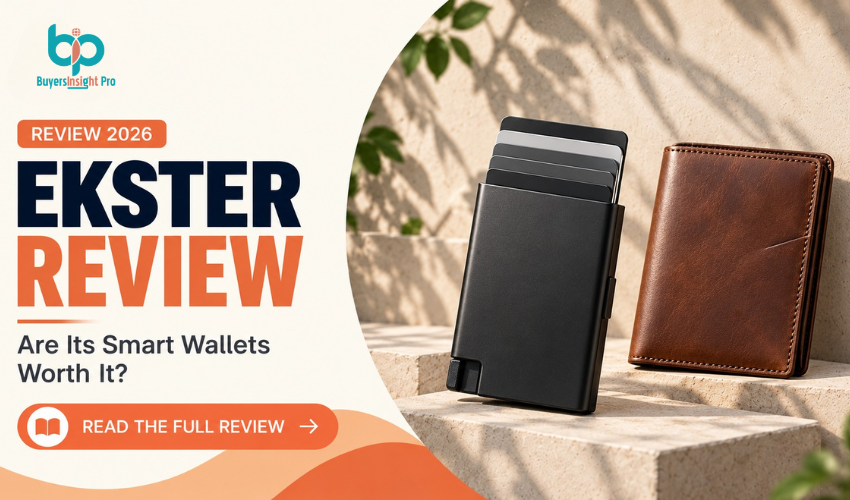
Introduction: A Better Wallet—or Another Expensive Accessory?
Your wallet probably contains a few cards you use constantly and several things you rarely touch. Ekster’s pitch is to make the useful part easier to reach while reducing everything else. This Ekster review examines whether that improvement justifies the price. The pop-up mechanism looks satisfying, but buyers also need answers about card security, durability, cash storage and the difference between the standard Cardholder and Cardholder Pro.
There is another detail worth checking: a “smart wallet” does not necessarily include a tracker. The wallet and tracking accessory are separate purchases unless a selected bundle explicitly includes both.
Below, we compare the main formats, explain their practical limitations and examine Ekster vs Ridge. The aim is to help you choose a wallet that fits your actual routine.
Review approach: This is a research-based buying assessment using official specifications, published hands-on reviews and customer feedback. It does not claim personal unboxing or long-term testing. Prices and purchase information were checked on October 9, 2026. The rating reflects convenience, design, value and buying limitations.
Check Today's Price
What Is Ekster?
Ekster sells wallets, trackers and other everyday-carry accessories. Its founders, Olivier and Rick, describe starting the business after meeting during a Fulbright scholarship in the United States and sharing a frustration with bulky bifolds. The company’s story traces its growth through a Kickstarter campaign. Its wallets centre on a straightforward idea: keep frequently used cards inside a rigid holder and reveal them with a button instead of searching through individual pockets.
That approach suits commuters, travellers and anyone who pays mainly by card. It is less accommodating to people who carry considerable cash, loose change, receipts or unusually shaped documents. The range includes metal cardholders, leather-covered wallets and MagSafe products. They share a family resemblance, but their storage, mechanisms and accessory compatibility differ.
Ekster Cardholder Review: The Standard Model
The standard Ekster Cardholder combines an aluminium body with a pop-up mechanism and expandable backplate storage. Ekster distinguishes its plastic button and mechanism from the Pro’s metal components. Its appeal is immediate: cards become easier to see, and there are fewer separate pockets to search. However, the advertised capacity includes exterior storage. Ekster’s manual recommends a maximum of four embossed cards or six non-embossed cards in the main chamber. Additional cards sit beneath the backplate rather than participating in the same pop-up action.
This distinction changes the buying decision. Someone carrying five everyday cards has a different experience from someone carrying twelve and expecting every card to appear at the push of a button. The standard model is worth considering when it costs meaningfully less than the Pro. When promotions narrow that difference, the upgraded model becomes more attractive.
Ekster Cardholder Pro Review: The Most Compelling Upgrade
The Cardholder Pro changes more than the finish. Ekster’s support documentation identifies an all-metal ejector, a flush trigger and rounded corners. It lists total storage of up to fourteen cards, with five to seven in the main cardholder. These upgrades address parts of the wallet you interact with repeatedly. The trigger matters each time you pay, while the edges affect handling and pocket comfort. An all-metal mechanism is a reason to prefer the Pro, but it does not prove that every unit will outlast the standard version. Long-term reliability also depends on tolerances, card loading, damage and use.
Its practical advantage is strongest for someone carrying a modest set of frequently used cards. The exterior storage remains useful for backup cards and folded bills, but filling everything to capacity changes the pocket profile. The Pro also receives lifetime manufacturing-defect coverage under Ekster’s published warranty policy. That protection excludes loss, theft, normal wear and damage unrelated to manufacturing.
Ekster Wallet Review: Who Should Choose Leather?
The Ekster Wallet wraps the card-access concept in a more traditional exterior. The current product page describes Vachetta leather and recycled aluminium construction. This is the more natural choice if a bare metal cardholder feels too industrial. The covering gives it a familiar wallet appearance while retaining quick access to the central card stack. The trade-off is additional material and a different ageing process. Leather develops creases and marks; whether that looks appealing depends on your expectations.
Do not assume every finish uses identical materials. Check the selected colour and variant description, particularly where alternative materials appear in the range. The leather format is also distinct from the newer Wallet Pro. Similar product names can make comparisons confusing, so verify the full model name and bundle contents before ordering. For buyers choosing mainly on appearance, the leather wallet may be the better purchase. For those prioritising the upgraded ejector and minimal exterior, the Cardholder Pro deserves closer attention.
Key Features: What Actually Improves Everyday Use?
Pop-Up Card Access
The ejector presents cards in a staggered arrangement, making them easier to distinguish than a tightly packed stack. That is useful when you switch regularly between a payment card, identification and a transit card. It can also reduce the repeated bending and searching associated with overfilled leather pockets. The limitation is that card access remains physical. A less accessible card may require removing more of the stack, and thick or unusually textured cards can affect how smoothly the chamber operates. Arrange your cards deliberately rather than treating the holder as a container to fill indiscriminately.
RFID Protection
Ekster advertises RFID protection for its cardholders. This applies to the protective housing; it should not be assumed to extend equally to cards held outside that enclosure. The sensible reason to buy Ekster is its organisation and access. RFID shielding is an additional feature, not comprehensive protection against payment fraud. It does not protect you from phishing, compromised online accounts or handing card details to an untrustworthy website.
Expandable Storage
The backplate lets the wallet accommodate occasional extra cards and folded cash. That flexibility is useful for travel, but capacity and slimness are competing priorities. Add backup cards, bills and a tracker, and the finished wallet becomes thicker than the empty product photograph suggests. Choose based on your typical load rather than the maximum advertised number.
Optional Tracking
The current Tracker Card supports Apple Find My or Google Find Hub, operates on one network at a time and charges wirelessly. Ekster lists a 1.8mm profile, battery life of up to ten months and no subscription fee. These are manufacturer specifications, not results independently tested here. Older Finder Cards and MagSafe-specific trackers have different specifications. Check the exact accessory rather than relying on an older review. A tracker can help locate a misplaced wallet. Its usefulness still depends on charge, pairing and network conditions. “Trackable” does not guarantee immediate recovery.
First Impressions: Packaging, Design and Setup
Ekster’s product presentation is polished, with coordinated colours and matching accessories. It makes the wallets appealing as gifts, although presentation alone tells you little about durability. This review does not assess a delivered package. Buyers should verify the order contents rather than assuming a tracker, cash clip or other accessory is included. Basic wallet setup is straightforward. Remove the supplied demonstration cards, insert your everyday cards and check that they eject and return smoothly. Ekster recommends placing frequently used cards toward the back of the standard chamber for easier access.
Start below maximum capacity. If the mechanism feels resistant, reduce the load rather than forcing the trigger. For a tracker bundle, follow the instructions for that generation, pair it with the appropriate finding app and confirm that it rings before relying on it. Initial expectations should remain practical: a tidier pocket and easier card access are realistic aims. Eliminating every inconvenience of carrying a wallet is not.
Performance and Real-World Usability
Where Ekster Works Well
Ekster’s strongest use case is a person carrying several everyday cards and a small cash reserve. In The Gadgeteer’s hands-on Cardholder Pro review, Danny Welsch reported a successful transition from a traditional billfold. He appreciated its compactness and card retention, while noting the adjustment to limited cash storage and front-pocket carry. The review disclosed a manufacturer-supplied sample.
That experience illustrates the underlying benefit: the wallet becomes more useful when its owner already needs to carry less. It is easier to recommend Ekster to someone who wants to reorganise an existing small card collection than to someone hoping it will compress a heavily stuffed bifold.
Where It Can Become Frustrating
The ejector introduces a moving component. That component is the selling point, but it also creates another possible failure or jamming point. Card thickness matters more than a simple count. Embossed cards, metal cards and heavily worn cards can produce a different fit from thin, flat plastic cards. Exterior storage also requires a separate action. If you repeatedly need something beneath the backplate, the one-button experience covers only part of your routine. Cash is another compromise. A few folded bills are manageable; frequent cash payments require more folding, sorting and reinserting than a conventional bill compartment.
Comfort and Everyday Wear
A rigid wallet feels different from leather, particularly in fitted clothing. Front-pocket carry is the sensible starting point, and the loaded wallet deserves the comfort assessment not the empty shell. The Gadgeteer reviewer also noted the possibility of a metal wallet scratching a phone when handled together. Keeping hard objects separated is a practical precaution. Expect visible wear with use. Cosmetic marks do not necessarily affect function, but a premium finish should not be mistaken for a finish that stays pristine indefinitely.
Pricing and Value Analysis: Is Ekster Worth It?
Ekster’s prices depend on model, finish, promotion and bundle.
The checked US pages displayed $99 for the standard Cardholder, paired figures of $95 and $119 for the Cardholder Pro, and $88 and $110 for the leather Ekster Wallet. Promotional price labels were inconsistently ordered in the retrieved pages, so the lower figures should not be treated as guaranteed checkout prices.
| Product | Checked US price information | Buying implication |
| Standard Cardholder | $99 on its product page | Compare against the Pro before buying |
| Cardholder Pro | $95 and $119 displayed with promotional messaging | Confirm the selected finish and cart total |
| Ekster Wallet | $88 and $110 displayed with promotional messaging | Choose for the leather format |
| Current Tracker Card | $39 listed elsewhere on the storefront | Additional cost unless bundled |
| Cardholder Pro for MagSafe | $129 displayed | Relevant when phone attachment matters |
Tracker and MagSafe figures came from the checked storefront listings. The Pro’s premium is easiest to justify when the actual price difference is modest. Its upgraded mechanism and warranty are more relevant than simply choosing a fashionable colour. Accessories deserve a separate decision. A tracker solves a different problem from a cash clip, and a bundle is good value only when you want its contents.
Returns and Warranty: Read Beyond the Banner
Ekster’s recently updated return policy gives customers 100 days from delivery and permits loading the item to assess fit, provided it remains good as new. Refund handling fees vary by location; the table lists $8.99 for standard items in applicable regions. Custom engraving and other exclusions apply. Another support page retains stricter “unused” wording. Confirm eligibility before extended use or personalisation, and obtain return authorisation.
The warranty support page describes two-year manufacturing-defect coverage generally and lifetime coverage specifically for the Cardholder Pro. Some newer product pages use broader lifetime language. Confirm coverage for your exact model instead of applying the site banner to every product.
Explore BRAND Collections
Ekster Pros and Cons
| Pros | Cons |
| Convenient access to frequently used cards | The pop-up chamber holds fewer cards than total capacity |
| Several formats and finishes | Accessories increase cost and thickness |
| Pro upgrades the ejector to metal | Moving parts introduce potential maintenance issues |
| Tracker options support wallet finding | Tracking requires a compatible, charged accessory |
| Compact format encourages lighter carry | Less convenient for substantial cash or coins |
| Published return and warranty support | Conditions, fees and model-specific coverage require attention |
Who Should Buy Ekster?
Ekster suits someone who pays mainly by card and wants to reduce wallet clutter. The Cardholder Pro is the most convincing choice when you value the metal mechanism and its price is close to the standard model. The leather wallet makes more sense when appearance and a familiar exterior matter more. A tracker is worth considering if misplacing your wallet is a recurring problem. It is less compelling as an automatic addition for someone who already keeps their belongings organised.
| Your Priority | Recommended Direction |
| Quick access to a modest card collection | Cardholder Pro |
| Lowest Ekster purchase price | Compare current standard and Pro offers |
| Traditional wallet appearance | Ekster Wallet |
| Finding a frequently misplaced wallet | Compatible tracker accessory |
| Attaching the wallet to a phone | MagSafe model after checking compatibility |
| Carrying considerable cash | Conventional billfold |
Who Should Avoid Ekster?
Cash-heavy users should think carefully before switching. A cardholder can accommodate folded bills without being convenient for repeated cash transactions. People carrying many thick cards may also find the mechanism less suitable than its maximum capacity suggests. Skip the accessory ecosystem if your goal is simply the cheapest way to carry three cards. An ordinary card sleeve performs that task without a trigger, tracker or charging routine. A soft wallet may also suit you better if you dislike rigid objects in your pockets. Slimness is useful only when the resulting shape is comfortable.
Ekster Reviews: What Customers Report
Ekster’s Trustpilot profile displayed 4.3/5 from 3,141 reviews when checked. This covers the wider company, including products beyond wallets, so it is not a Cardholder Pro reliability score. Positive feedback includes long ownership experiences and satisfactory replacements. One recent reviewer praised support after an older wallet stopped retaining cards. Critical feedback includes jamming and difficulty accessing cards. A recent customer reported problems despite carrying five cards, showing why fit cannot be predicted from count alone.
Some reviews concern non-wallet products, and others celebrate support after a fault. Read the model and context before interpreting the rating. The useful conclusion is balanced: there are satisfied long-term owners and documented complaints. Available reviews do not establish what percentage of wallets develop problems.
Ekster vs Ridge: Which Wallet Makes More Sense?
The main difference is how you retrieve your cards. Ekster uses an ejector. Ridge uses an elastic card stack between protective plates, with a thumb opening for access. Ridge’s current aluminium listing describes capacity for one to twelve cards and replaceable components.
| Feature | Ekster Cardholder Pro | Ridge Aluminium Wallet | Secrid Miniwallet |
| Card access | Button-operated pop-up | Thumb access to an elastic stack | Lever-operated pop-up |
| Storage approach | Chamber plus exterior backplate | Expandable stack between plates | Cardprotector plus leather wrap |
| Main appeal | Fast card presentation | Straightforward modular format | Familiar exterior and extra storage |
| Cash arrangement | Folded bills beneath exterior storage or accessory | Cash strap or money clip | Storage within the wrap |
| Best fit | Card-focused users who enjoy the ejector | Users who prefer fewer ejector components | Users wanting a compact leather wallet |
Secrid’s official listing separates four embossed or six flat cards in its Cardprotector from additional exterior storage.
Choose Ekster for Card Presentation
Ekster makes more sense when revealing cards neatly is the feature you want. You should also be comfortable keeping the chamber within its practical loading limits.
Choose Ridge for Its Different Mechanism
Ridge avoids a pop-up ejector, although elastic and other components still experience wear. It deserves consideration if you prefer pushing out a stack to pressing a trigger. Neither format wins universally. The decision is more about handling than about which brand has the more impressive specification sheet.
Frequently Asked Questions
1. Is Ekster legit?
Yes. Ekster has an active product range, published support policies and independently reviewed wallets. Legitimacy does not guarantee that every product or support experience will satisfy every buyer.
2. Is Ekster worth it?
Ekster can be worth it when quick card access and lighter carry solve an everyday frustration. It is harder to justify if an inexpensive card sleeve already meets your needs.
3. What is the difference between the Cardholder and Cardholder Pro?
The Pro upgrades the button and ejector to metal, increases advertised capacity and receives lifetime manufacturing-defect coverage. The standard model uses a different mechanism and has a lower stated total capacity.
4. Does the Cardholder Pro hold fourteen cards inside?
No. Its advertised total includes exterior storage. Ekster lists five to seven cards in the main chamber, with the remaining capacity outside it.
5. Does an Ekster wallet include a tracker?
Not necessarily. A standalone wallet should not be assumed to include tracking hardware. Check the selected product or bundle contents.
6. Does the current Tracker Card work with Android?
Yes. The current Tracker Card supports Google Find Hub or Apple Find My, with one network active at a time. Older tracker models have different compatibility.
7. Can you carry cash in an Ekster wallet?
Yes, but the cardholders are better suited to a few folded bills than substantial cash. Choose the specific wallet format and accessory arrangement accordingly.
8. Can Ekster wallets jam?
Customer reports include jamming and difficult ejection. Card thickness, loading and mechanical faults can affect operation. Avoid forcing a resistant trigger and contact support if problems persist.
9. Does Ekster offer a lifetime warranty?
The support policy specifically identifies lifetime manufacturing-defect coverage for Cardholder Pro. Confirm other models’ coverage, and remember that loss, theft and ordinary wear are excluded.
10. Is Ekster better than Ridge?
Ekster suits buyers who prefer pop-up access. Ridge suits buyers who prefer an elastic card stack. Your actual cards, cash requirements and handling preference should decide the comparison.
Final Verdict: A Useful Upgrade for the Right Routine
Ekster’s appeal rests on a feature you can use every day: easier access to the cards you need. The Cardholder Pro is the strongest overall recommendation here when its actual selling price is close to the standard version. Its upgraded mechanism and warranty give the premium a practical basis. Choose the leather wallet if that format feels more natural. Skip the range if you carry substantial cash, dislike rigid wallets or want the cheapest possible card storage.
Final Rating: 8/10. Ekster offers good convenience and thoughtful options, with capacity, accessory costs and purchase conditions that deserve careful attention.
Shop BRAND Now
Can I write you?
Sign up to get my weekly newsletter.
Trending Stories


Best Seller