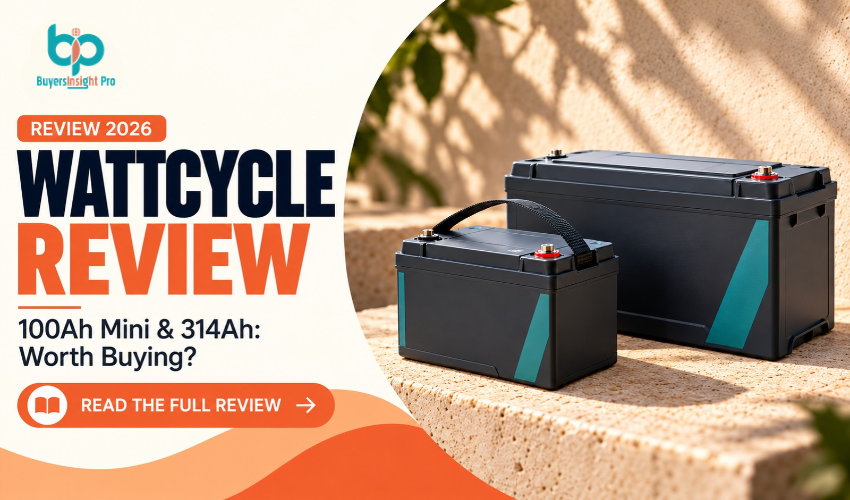
A lithium battery can look like a bargain until you discover that its current limit will not support your inverter, its case will not fit the compartment, or its charger needs replacing too. This WattCycle review focuses on those ownership questions: which battery suits your load, what Bluetooth adds, and where an attractive capacity figure can hide an expensive mismatch.
The main contenders are the 12V 100Ah Mini, its Bluetooth counterpart, the larger 314Ah Mini Bluetooth and a dedicated trolling-motor option. This is a research-based assessment of published specifications, current US pricing and owner feedback, rather than a hands-on capacity test. Prices were checked on October 26, 2026; the recommendations depend on the exact model and your installation.
Start with the battery that fits your system
Compare dimensions, continuous current and the selected model’s manual before deciding how much capacity to buy.
Explore WattCycle BatteriesWhat is WattCycle?
WattCycle sells lithium iron phosphate batteries, chargers and energy-storage equipment through its online storefront. The range covers portable deep-cycle uses as well as larger storage systems. For this review, the emphasis is on batteries a camper, RV owner or angler might realistically compare, rather than attempting to judge the entire catalog as one product.
A standalone battery is different from a portable power station. It does not automatically give you household sockets, a solar controller or an AC charger. The battery stores energy; the surrounding equipment determines how you charge it and what you can run. Anyone pricing a first system should account for that distinction before comparing a battery-only listing with an all-in-one power station.
WattCycle battery range: the meaningful differences
12V 100Ah Mini: small-case storage without built-in app monitoring
The standard 100Ah Mini listing specifies 1,280Wh, a 100A BMS, dimensions of 9.02 × 5.43 × 8.19 inches and a weight of 20.8 pounds. Its displayed single-battery price was $199.99. These are manufacturer figures, not measurements from this review. The appeal is straightforward: useful nominal storage in a case that may suit a narrow compartment.
In a WattCycle 12V 100Ah Mini review, fit deserves as much attention as capacity. Measure terminal clearance and cable access, not just the empty floor space. A smaller case can require a different hold-down or tray; it should not move around simply because it fits loosely in a compartment designed for a larger battery.
100Ah Mini Bluetooth: a modest price step for visibility
The 100Ah Mini Bluetooth was listed at $209.99, with 1,280Wh and a 100A BMS. WattCycle advertises app-based state-of-charge monitoring and charge/discharge controls. At the observed $10 difference, it is the more interesting starting point for buyers who want to check the battery without opening a storage compartment. Confirm the exact phone and app requirements before ordering.
Bluetooth adds information rather than extra energy. A percentage estimate can be convenient, but it should be checked against charging behavior and actual consumption when commissioning a system. In a multi-battery installation, a separate system monitor can also answer a different question: what is happening across the whole bank, rather than inside one case.
314Ah Mini Bluetooth: larger capacity, different handling
The 314Ah Mini Bluetooth listing showed $529.99, 4,019Wh and a 200A BMS, with dimensions of 15.12 × 7.64 × 9.76 inches and a listed weight of 59.52 pounds. Buyers searching for a WattCycle 314Ah battery review should note that this is substantially heavier than the 100Ah Mini. Check the shipping variant and current manual because similar names do not establish identical hardware.
One larger battery can simplify a layout that would otherwise need several smaller units, but it also concentrates storage in a single unit. If that battery is unavailable for service, the whole bank may be unavailable. Several batteries can offer different expansion and handling options, although they introduce more connections and require a properly designed arrangement.
Trolling-motor model: compare electrical demands first
For a WattCycle trolling motor battery review, the 100Ah TM Bluetooth model is particularly relevant. The listing showed $249.99, 1,280Wh, a 120A continuous BMS rating and an advertised IP67 enclosure rating. That gives it a different specification from the Mini. Motor compatibility still depends on operating voltage, maximum draw, transient requirements and the motor manufacturer’s instructions.
Do not choose solely from a thrust range or a photograph of a fishing boat. A 24V or 36V motor needs the correct supply architecture; a single 12V-class battery is not interchangeable with either. Starting an engine is another application again. Buy a battery explicitly approved for the required cranking duty rather than assuming a deep-cycle label covers it.
| Model reviewed | Nominal storage / BMS | Observed US price | Main shopping reason |
|---|---|---|---|
| 100Ah Mini | 1,280Wh / 100A | $199.99 | Compact basic storage |
| 100Ah Mini Bluetooth | 1,280Wh / 100A | $209.99 | Compact storage with app visibility |
| 314Ah Mini Bluetooth | 4,019Wh / 200A | $529.99 | Larger storage in one battery |
| 100Ah TM Bluetooth | 1,280Wh / 120A | $249.99 | Motor-oriented specification |
Design and first impressions: what the listings can establish
The Mini naming describes a packaging priority, not a different category of energy. Published dimensions make the 100Ah versions worth checking where space is tight. Product photographs are useful for planning terminal access and handle clearance, but they cannot establish the feel of the case, the quality of the delivered packaging or internal workmanship. Those require inspection of an actual unit.
On delivery, compare the label and model with the order, inspect for visible damage and retain the packaging. Download the matching manual before connecting anything. Record the serial number and purchase details, then commission the battery according to its instructions. This is more useful than judging quality from how impressive the carton looks.
Performance in practical use: capacity is only half the decision
Runtime depends on average load, losses and reserve
Amp-hours are meaningful only alongside voltage. For planning, watt-hours provide a more useful comparison across systems. A hypothetical 1,280Wh battery supplying a constant 100W load has an ideal arithmetic runtime of 12.8 hours. If you assume only 85% reaches the load after conversion losses and reserve, the planning estimate becomes roughly 10.9 hours. This is an illustration, not a measured WattCycle result.
A fridge does not necessarily draw its rated power continuously, while an inverter consumes some energy even when the appliance demand is low. Weather, usage patterns and the battery’s condition affect the result. Build an energy budget from realistic daily consumption rather than expecting a universal number of camping days from the battery label.
Continuous current matters for larger appliances
Stored energy and deliverable power are separate constraints. As a general calculation, a 2,000W AC load through a 90%-efficient inverter at 12.8V requires about 174A from the battery, before allowing for changing voltage or startup surges. That example explains why a high-energy battery can still be unsuitable for a particular appliance. Check every component’s continuous and transient limits.
A BMS cutoff is protection, not a normal control strategy. Repeated shutdowns call for diagnosis of the load, temperature, connections and charging arrangement. Larger loads also increase the importance of cable sizing, suitable overcurrent protection and secure connections. A qualified installer is a sensible investment when the system design exceeds your experience.
Cold-weather protection is different from heating
Low-temperature cutoff prevents charging outside a permitted temperature range; self-heating is a separate capability. A battery that refuses charge on a freezing morning may be protecting itself rather than failing. For winter use, establish the cell-temperature limits in the exact manual and decide how the installation will remain within them. Do not assume a Bluetooth badge implies built-in heating.
Charging compatibility deserves the same attention. Solar panels need a suitable controller, and an alternator-fed system needs an appropriate charging arrangement. An existing lead-acid charger should be checked for an approved lithium profile and any incompatible modes. A generator supplies electricity to a charger; it does not remove the need for one.
Pricing and value: compare the complete installation
Using the observed prices and advertised nominal energy, the basic Mini works out at approximately $156 per kWh, the Mini Bluetooth at $164 per kWh and the 314Ah Mini Bluetooth at $132 per kWh. These are purchase-price calculations, not lifetime energy costs. They exclude delivery charges where applicable, tax, losses, accessories and degradation, and they should be recalculated when prices change.
The larger model looks efficient on that narrow metric, but unused capacity is still money spent. A weekend setup may benefit more from a smaller battery and a properly matched charger. Conversely, buying too little storage can force an early redesign. Budget for the charger, monitor if needed, fuses, disconnects, cabling and installation alongside the battery.
The Mini Bluetooth’s small observed premium is easier to justify than paying for features you will never use. For the TM model, the decision should follow motor requirements rather than aesthetics. There is no verified coupon included here: checkout pricing and the exact new or refurbished condition take priority over a crossed-out list price.
Compare total cost before checking out
Shortlist the right capacity, then confirm the charger, monitoring and installation parts your setup needs.
Check Current Models and PricesWarranty, returns and the cost of changing your mind
The current US WattCycle warranty policy lists five years for new batteries, with two additional years activated through registration within three months of purchase. Like-new products receive one year. Keep proof of purchase and follow the installation requirements; normal aging and damage from misuse are among the exclusions. A warranty term is not a guarantee of zero capacity loss.
Returns deserve a careful read. The policy’s table allows personal-reason returns within 30 days with customer-paid return shipping and restocking fees, but another clause restricts refunds to qualifying defects. That wording needs clarification before purchase if a change-of-mind return is important to you. Request the applicable charges and eligibility in writing instead of interpreting a money-back badge as free return shipping.
WattCycle Pros and Cons
| Advantages | Limitations |
|---|---|
| Compact 100Ah case options suit space-conscious layouts. | Physical fit still requires secure mounting and cable clearance. |
| Bluetooth version had a small observed price premium. | App behavior and state-of-charge estimates need checking. |
| Several capacities and application-focused variants. | Similar model names can obscure important hardware differences. |
| Larger model offers attractive nominal energy per dollar. | A battery-only price excludes the rest of the power system. |
| Published warranty and registration process. | Return fees and inconsistent wording warrant clarification. |
Who should buy WattCycle—and who should skip it?
WattCycle belongs on the shortlist for buyers who can define their energy needs and compare electrical specifications. The smaller batteries are appealing where portability and compartment space matter. The larger model is more relevant when a measured consumption budget supports buying several kilowatt-hours of storage and the installation can accommodate its mass.
It is less compelling for someone seeking a ready-to-use box with outlets, charging inputs and minimal setup. Buyers who require a local dealer to handle diagnosis or replacement should establish that support route first. Anyone needing a guaranteed fit, verified certification for a particular installation or winter charging capability should obtain model-specific documentation before committing.
| Your priority | Option to investigate | Check before purchase |
|---|---|---|
| Small camping or RV system | 100Ah Mini / Mini Bluetooth | Fit, charger and load current |
| More storage in one case | 314Ah Mini Bluetooth | Handling, mounting and power budget |
| Compatible trolling-motor use | TM Bluetooth | Motor voltage and current requirements |
| Simple household plug-in backup | Portable power station category | Included inverter, charger and outputs |
Customer feedback: useful signals, limited proof
The owner feedback reviewed on Trustpilot includes accounts of helpful troubleshooting and resolving product issues. These reports are useful evidence of individual support experiences, but they cover different models and circumstances. A favorable interaction on a larger storage battery does not prove the reliability of a 100Ah Mini, and a star average cannot substitute for a capacity test.
A Reddit discussion about Bluetooth batteries describes app dissatisfaction and connection problems, alongside a follow-up from one participant saying the battery later worked normally. Treat that as a reason to check app compatibility and commissioning instructions, not a measured failure rate. Across WattCycle reviews, model identity, purchase date and the quality of the evidence matter more than isolated praise or frustration.
WattCycle versus LiTime, Renogy and Battle Born
The most useful competitor comparison matches functions before prices. Compare a compact smart battery with another compact smart battery, rather than assuming every 100Ah product includes the same monitoring or temperature features. Then examine the support route, applicable warranty and installation requirements. None of these alternatives has been independently tested for this article.
| Alternative | Verified point of difference | Decision to make |
|---|---|---|
| LiTime XtraMini Bluetooth | Compact smart 100Ah alternative with advertised low-temperature charging protection. | Compare fit, final price and app requirements. |
| Renogy Core Mini 100Ah | Built-in Bluetooth is absent; Renogy describes separate shunt-based monitoring. | Include monitoring accessories in the total. |
| Battle Born BB10012 | Standard battery advertised with US assembly and a ten-year warranty. | Decide what support and coverage are worth to you. |
| WattCycle Mini Bluetooth | Compact smart option at the observed $209.99 price. | Confirm the exact delivered specification and returns. |
WattCycle is attractive when initial cost and compact packaging carry substantial weight in the decision. Renogy’s monitoring approach may suit someone already planning a system shunt. Battle Born’s published warranty and assembly proposition justify comparison for buyers prioritizing those features. The best choice is the one that fits the system and ownership expectations, rather than the brand with the biggest headline capacity.
Frequently asked questions
Is WattCycle worth buying?
WattCycle is worth shortlisting when its exact battery specifications match your load, charger and installation space. Its observed prices make the Mini models competitive candidates, but this review does not independently verify capacity or long-term reliability. Compare total installed cost and clarify return conditions before buying.
What is the difference between the 100Ah Mini and Mini Bluetooth?
The models reviewed advertise the same 1,280Wh nominal energy and 100A BMS rating. The Bluetooth version adds app monitoring and controls. At the prices checked, it cost $10 more. Confirm the current model specification because features and hardware can change.
Can a WattCycle 100Ah battery run a 2,000W inverter?
A 100A-rated battery should not be selected to deliver a continuous 2,000W AC load. At 12.8V and an assumed 90% inverter efficiency, that load requires about 174A. Inverter nameplate size alone does not determine consumption, so evaluate the actual appliances, surge demand and all component limits.
Is the WattCycle 314Ah Mini better than three 100Ah batteries?
It offers more advertised nominal energy than three 100Ah units at the same nominal voltage, and one case can simplify an installation. However, it is heavier to handle as a single unit and concentrates storage in one battery. Multiple-battery systems have different wiring, expansion and service considerations.
Are WattCycle batteries suitable for trolling motors?
A suitable model may work when the motor manufacturer permits the battery chemistry and the voltage and current requirements match. The TM Bluetooth model has a different BMS specification from the Mini. Check the complete motor system rather than choosing solely by amp-hours or advertised thrust range.
Does low-temperature protection mean self-heating?
No. Low-temperature protection can stop charging outside the permitted range; self-heating requires separate hardware and control behavior. Check the selected model’s manual for temperature limits and heating specifications. Plan winter installations around cell temperature rather than assuming the enclosure stays warm.
Do WattCycle batteries include a charger or inverter?
Do not assume either is included in a standalone battery purchase. Check the contents of the exact listing or bundle. A complete system may also need a controller, suitable cables, overcurrent protection and a disconnect, depending on its application and design.
How long is the WattCycle warranty?
The current US policy checked for this review lists five years for new batteries and a two-year extension activated by registration within three months of purchase. Like-new products have one year. Coverage is subject to the applicable policy, proof of purchase and exclusions.
Can you return a WattCycle battery if it does not fit?
Confirm eligibility and charges with WattCycle before ordering. The current US policy includes customer-paid shipping and restocking fees for personal-reason returns, while another refund clause is more restrictive. Keep the original packaging and obtain written clarification rather than assuming an opened battery can be returned without cost.
Where should you buy WattCycle batteries?
The official storefront lets you compare current model specifications and access the relevant manuals and policies. If buying through a marketplace or distributor, confirm the seller, battery condition, regional coverage and return route. Retain the invoice and register an eligible product within the required period.
Final verdict: good reasons to compare, no shortcut around sizing
WattCycle offers a persuasive starting point for cost-conscious battery shoppers, especially when a compact case matters. The Mini Bluetooth is the clearest model to investigate first at the observed prices; the 314Ah Mini becomes more relevant when your energy budget supports larger storage. The motor-oriented option deserves a separate comparison for anglers instead of being treated as another interchangeable 100Ah battery.
Skip a battery-only purchase if you need a complete portable power system or cannot establish compatibility. The overall value depends on fit, current capability, charging and support as much as nominal capacity. A numerical performance score would overstate what desk research can establish, so the verdict is conditional: a worthwhile shortlist, supported by model-specific checks before checkout.
Choose by your load, space and charging plan
Review the current model manual and ask WattCycle to confirm any unresolved compatibility or return questions before purchasing.
Explore the Official WattCycle Range