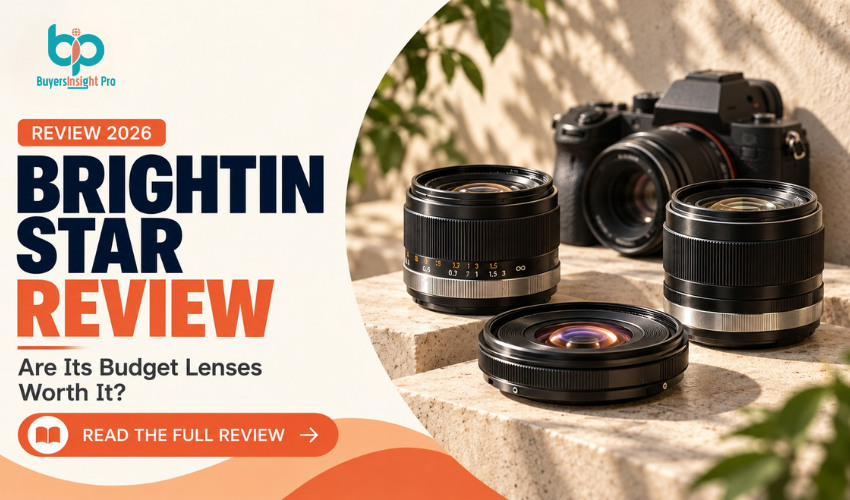
Brightin Star Review: Are Its Budget Camera Lenses Worth It?
-
October 09 , 2026
-
38
Why consider Brightin Star?
A lens with an f/0.95 aperture for around $200 is difficult to ignore. So is a pancake lens that barely protrudes from a camera. This Brightin Star review starts with the question those specifications leave unanswered: will the lens make your photography more enjoyable, or make it harder to get the photograph you want?
There is no single answer across the range. A portrait prime, a full-frame 35mm and a fisheye solve different problems. Some offer a distinctive look at an accessible price; others demand compromises that the headline specifications barely suggest.
This guide compares the requested models, explains setup and focusing, examines published testing and checks the purchase terms. It separates the older APS-C 50mm f/0.95 from the newer full-frame version.
Review method: This is a research-based assessment of official specifications and published first-hand reviews. It does not claim personal unboxing, shooting sessions or independently measured sharpness. US-dollar prices were checked on 9 October 2026; selected mounts, finishes and bundles can change the total.
Check Today's Price
What is Brightin Star?
Brightin Star describes itself as an optical brand founded in Shenzhen, China, in 2018. Its current range includes manual-focus and autofocus lenses for mirrorless cameras, covering portrait, macro, wide-angle and specialist photography. The lenses featured here are manual-focus products. That is central to their appeal and their limitations: you are buying physical control over focus and aperture, often with fewer electronic conveniences than a modern native lens. The strongest reason to buy is access to a particular photographic experience. Brightin Star is less convincing as a blanket replacement for dependable autofocus lenses used to capture unpredictable moments.
Key features: what matters beyond the aperture number
Manual focus changes the workflow
With these lenses, you turn the focus ring yourself. A camera may offer focus peaking or magnified live view, but those aids do not turn the lens into an autofocus product. This works well when you can take a moment to inspect the subject: a seated portrait, a still life or a carefully composed detail. It becomes more demanding when a child runs toward you or a subject changes distance unexpectedly.
Fast apertures offer creative freedom with a cost
An f/0.95 lens allows a much wider aperture than an f/2.8 lens. In comparable conditions, that creates scope for faster shutter speeds or lower ISO settings, subject to actual light transmission. It also narrows the zone of acceptable focus. At close portrait distances, focusing on eyelashes instead of the eye can make the result look softer than the lens is capable of producing.
Mount compatibility and sensor coverage are separate
Sony E, Nikon Z and Canon RF mounts appear on cameras with different sensor sizes. A lens fitting the mount does not prove it covers the entire sensor. An APS-C lens on a compatible full-frame body generally requires crop mode or acceptance of incomplete coverage. A full-frame lens on APS-C gives a narrower field of view than it does on full frame. On a typical 1.5× APS-C camera, 35mm gives approximately the framing of a 52.5mm full-frame lens; on Canon’s 1.6× APS-C format, it is approximately 56mm. On Micro Four Thirds, 35mm gives approximately a 70mm-equivalent field of view. The physical focal length remains 35mm.
Brightin Star 35mm f0.95 review: the creative APS-C option
The 35mm f/0.95 is listed as an APS-C manual prime, with mount options including Fujifilm X, Sony E, Nikon Z, Canon RF, EOS M and Micro Four Thirds. Its metal construction and wide aperture make it an appealing entry into a more deliberate shooting style. On APS-C, the focal length sits close to a normal view, making it useful for details, informal portraits and everyday compositions. On Micro Four Thirds, the tighter framing leans more toward portrait work.
Published experience supports treating it as a character lens. Florian Kunde’s Fujifilm X-T4 review found usable focused detail wide open and appealing background blur, alongside substantial flare and visible colour fringing. He disclosed receiving the lens from the manufacturer. Thomas Eisl’s Micro Four Thirds testing also favoured it for portraits and still-life subjects, while identifying longitudinal chromatic aberration and flare limitations. Those findings apply to his tested format and sample, rather than establishing identical performance on every camera.
This is the most natural shortlist choice here for an APS-C photographer who specifically wants an affordable f/0.95 look. It is a more questionable choice if clean backlit files and rapid focusing are essential.
Brightin Star 35mm f1.4 review: compact, but optically demanding
The current 35mm f/1.4 is a full-frame manual prime. Brightin Star lists a 218g design, 0.3m minimum focusing distance, ten aperture blades and a switchable clicked/clickless aperture ring. Mount choices include Sony E, Canon RF, Nikon Z, L and Fujifilm X. Its compactness is meaningful: a smaller lens can make a camera easier to carry. Full-frame users get a moderately wide everyday view; APS-C users get tighter, normal-lens framing.
The optical qualifications are substantial. Marc Alhadeff’s Sony Alpha Blog test on a 61-megapixel A7R V reported modest wide-open sharpness, improvement when stopped down and focus shift as the aperture changed. The same review appreciated colour, background blur and build. Focus shift deserves more attention than a flattering sample portrait. If the focus plane moves after changing aperture, focusing at one setting and exposing at another can leave the intended detail soft. Focus again at the taking aperture when possible. Consider this lens for compactness and a softer rendering preference. Do not buy it assuming that an f/1.4 label guarantees modern autofocus-prime sharpness at maximum aperture.
Brightin Star 50mm f0.95 review: which version?
The APS-C 50mm f/0.95 Night God and the 50mm f/0.95 II full-frame lens are separate products. They have different coverage, specifications and prices. A review of one should not settle a purchase of the other. The APS-C model is listed with a 13-blade diaphragm, clicked aperture ring and retractable hood. On a 1.5× APS-C body, its field of view is approximately that of a 75mm full-frame lens, which suits tighter portraits. The full-frame II version provides the familiar 50mm field of view on full frame and is listed with nine aperture blades and a built-in retractable hood.
The buying logic is straightforward: choose according to the camera format and framing you want. A longer portrait-style view needs more working distance indoors, while either lens at f/0.95 rewards careful focus. This assessment does not include a verified side-by-side optical test of both versions. It therefore cannot declare the newer lens sharper or its bokeh better merely because it costs more.
Brightin Star 28mm f2.8 review: portability comes first
The 28mm f/2.8 pancake is a full-frame Leica M-mount lens with rangefinder coupling. The current listing describes a 9.9mm profile and 125g weight. Adapting it to other systems requires checking the specific lens, adapter and camera combination. Its appeal is clear for travel and street photography: a very slim lens keeps a camera unobtrusive. However, adding an adapter increases the overall size, and M-mount fit is not a universal clearance guarantee. Bastian Kratzke’s review of the earlier Funleader × Brightin Star 28mm f/2.8 XSlim Pro-M found strong field curvature, barrel distortion and weak corners for landscape use. Flare control and sunstars received a more favourable assessment.
That older test is useful context, but the current listing does not establish that every finish or revision is optically identical to the tested sample. Look for images from the exact version you intend to buy. The recommendation is narrow: consider it because compactness is central to your photography. For critical architecture, demand evidence of corner performance before ordering.
Brightin Star 7.5mm f2.8 review: embrace the fisheye
The current IV version is a manual-focus fisheye, listed with a 190-degree perspective and mount options covering several APS-C systems plus Micro Four Thirds. Do not carry older-generation specifications into this purchase without checking them. Fisheye projection deliberately bends lines away from the centre. That can make skateboarding, dramatic interiors and playful close compositions more expressive. It is usually the wrong starting point for conventional property photographs with straight architectural lines.
Composition is the bigger practical adjustment. Small changes in camera position alter the image dramatically; feet, fingers and equipment can enter the frame unexpectedly. Keep important faces away from stretched edges unless distortion is intentional. There is no controlled sharpness assessment of this lens in this article. The recommendation is based on its projection, specifications and likely use—not invented claims about corner detail or night-sky performance.
First impressions and setup
Official images suggest a range with strong retro styling and hands-on controls. Several listings describe metal construction, but metal alone does not establish weather sealing, impact resistance or long-term reliability. Packaging contents should be checked for the exact SKU. Do not assume every model includes a hood, pouch or filter. A retractable hood on one lens says nothing about the accessories supplied with another. For a lens without electronic communication, your camera may require a setting that permits shooting without a detected lens. Consult the camera manual, enable magnification or peaking as appropriate, and enter the focal length for stabilisation if the body requires it. Begin with a stationary subject in good light. Take several photographs at different apertures and inspect focus before trying a dim, moving subject at maximum aperture. This separates a setup problem from a demanding shooting situation.
Real-world performance: where these lenses make sense
Portraits and everyday details
The fast primes offer their strongest practical proposition when you control distance and timing. A cooperative subject and carefully selected background make shallow depth of field easier to use effectively.
More blur is not always better. For a three-quarter portrait, an aperture that leaves both eyes acceptably focused may produce a stronger photograph than the widest possible setting.
Street photography and moving subjects
Manual focus can work well for street photography with anticipation or zone focusing. However, engraved distance scales should be checked against your own camera and results before relying on them.
At wide apertures, zone focusing offers much less tolerance. For unpredictable family moments or paid events, a compatible autofocus prime is often the more practical purchase—even if its maximum aperture is smaller.
Landscapes and night scenes
Stopping down can improve detail, but it does not automatically cure field curvature, decentring or every aberration. The published 28mm test illustrates why a centre-focused landscape can still have weak corners.
Likewise, a fast aperture is not sufficient evidence for astrophotography suitability. Inspect star shapes near the edges, infinity focusing and flare before making a lens your night-sky recommendation.
Pricing and value analysis
The checked US storefront places the featured lenses in several distinct price brackets. These are displayed prices, not guaranteed delivered totals.
| Lens | Displayed price | Main value proposition |
| 35mm f/0.95 APS-C | $189.99 | Affordable wide-aperture experimentation |
| 35mm f/1.4 full frame | $189.99 for the checked standard variant | Compact full-frame manual prime |
| 50mm f/0.95 APS-C | $199.99 | Tight portrait framing on APS-C |
| 50mm f/0.95 II full frame | $399.99 | Full-frame f/0.95 option |
| 28mm f/2.8 Leica M | From $318.99 in the collection; selected Liquid Silver page showed $358.99 | Specialist ultra-slim design |
| 7.5mm f/2.8 IV fisheye | $149.99 | Creative fisheye perspective |
Prices are drawn from the official product listings linked above and the manual-lens collection. Allow for adapters, filters, taxes and destination-specific delivery arrangements. The strongest value comes from buying an effect you will use. A low-cost fisheye can make sense as a specialist addition; a fast manual prime can be worthwhile for controlled portraits. A cheaper lens is poor value if focusing demands make you leave it at home.
Return and warranty terms affect the bargain
The direct store advertises 90-day returns, but its published policy excludes change-of-mind returns and lists discount-code or gift-card orders among exclusions. A customer-selected wrong model can involve shipping costs and a 40% restocking fee. Approval is required before sending anything back. Treat this as a restricted policy, not a trial period.
The warranty page describes two-year limited coverage for eligible manufacturing defects, with customer-paid inbound shipping after the initial 30 days. However, the returns page also states that repair costs become the customer’s responsibility after one year. Ask for written clarification of second-year coverage before making it a deciding factor.
Explore BRAND Collections
Pros and cons
| Pros | Cons |
| Accessible fast-aperture options | Precise manual focusing takes practice |
| Distinctive creative rendering | Optical compromises vary substantially by model |
| Physical focus and aperture controls | Featured manual lenses sacrifice autofocus convenience |
| Compact and specialist designs | Mount fit does not establish sensor coverage |
| Several mount variants | Similar names can hide different generations |
| Prices suitable for a second lens | Direct-store returns and warranty wording need attention |
Who should buy Brightin Star?
Buyers who enjoy the process of photography are the best fit. If you like slowing down, inspecting focus and working around an optical personality, these lenses can bring variety to an existing kit. The strongest purchase is usually specific: an APS-C f/0.95 prime for controlled portraits, a fisheye for exaggerated compositions or a pancake because carrying less equipment genuinely matters.
| Your priority | Sensible shortlist |
| Normal framing and wide-aperture effects on APS-C | 35mm f/0.95 |
| Compact full-frame 35mm with manual controls | 35mm f/1.4, after reviewing focus-shift evidence |
| Tighter APS-C portraits | 50mm f/0.95 APS-C |
| Full-frame 50mm at f/0.95 | 50mm f/0.95 II |
| Minimal bulk on a compatible M camera | 28mm f/2.8 |
| Deliberate fisheye distortion | 7.5mm f/2.8 IV |
Who should avoid these lenses?
Photographers who depend on rapid autofocus should prioritise a compatible AF lens. That includes many sports, wildlife, wedding and family-photography situations. Also look elsewhere if you require consistently neutral rendering, dependable electronic lens information or proven weather sealing. Do not infer those features from attractive machining or a wide-aperture label.
Brightin Star reviews: owner and reviewer feedback
The positive themes in the first-hand material examined are tactile handling, appealing background blur and enjoyment of a distinctive look. Critical themes include focusing difficulty, flare, colour fringing and model-specific sharpness limitations. An owner-style Fujifilm post about the 35mm f/1.4 praised its colours and carefully focused images but reported trouble trusting the distance scale for zone focusing. The author disclosed a manufacturer-supplied review lens. It is a useful individual experience, not evidence of a universal calibration fault.
Manufacturer-supplied samples appear in some favourable reviews, so those disclosures deserve attention. Store-hosted ratings are another limited signal: they do not replace independent testing or establish a verified defect rate. Read sample photographs alongside the commentary. Whether you like the rendering matters, but so does the effort required to achieve it.
Brightin Star vs TTArtisan, 7Artisans and Viltrox
For APS-C shoppers, these are useful alternatives with different priorities. The table compares their functions rather than inventing a universal optical ranking.
| Option | Focus and coverage | Main reason to compare | Buying limitation |
| Brightin Star 35mm f/0.95 | Manual, APS-C | Creative rendering and physical controls | Wide-open focusing and flare demands |
| TTArtisan 35mm f/0.95 | Manual, APS-C | Similar aperture class; listed weight around 247–267g | Check exact mount and sample performance |
| 7Artisans 35mm f/0.95 | Manual, APS-C | Another direct rival in the fast-prime category | Version, availability and aperture handling matter |
| Viltrox AF 35mm f/1.7 Air | Autofocus, APS-C | Electronic focusing convenience and a lighter design | Smaller maximum aperture; mount-specific support |
Sources: official TTArtisan, 7Artisans and Viltrox listings. Brightin Star competes convincingly when the maximum aperture and manual experience are the attraction. Viltrox deserves closer attention when your frustration is missed focus rather than insufficient background blur. Do not treat visually similar Brightin Star and 7Artisans lenses as interchangeable without checking the exact model. Shared-looking barrels do not establish identical quality control, coatings or purchase protection.
FAQ
Is Brightin Star a legitimate lens brand?
Brightin Star has an active product range, published specifications and independently documented lenses. That supports its legitimacy as a brand, but does not guarantee every model will suit your needs.
Are all Brightin Star lenses manual focus?
No. The brand also lists autofocus products. The 35mm f/0.95, 35mm f/1.4, featured 50mm f/0.95 versions, 28mm f/2.8 and 7.5mm f/2.8 IV discussed here are manual-focus lenses.
Is the Brightin Star 35mm f/0.95 full frame?
The featured 35mm f/0.95 is listed for APS-C coverage, with a Micro Four Thirds mount option also available. A full-frame-compatible mount does not change its stated coverage.
What is the difference between the two 50mm f/0.95 lenses?
The Night God model is listed for APS-C, while the 50mm f/0.95 II is listed for full frame. They are separate products with different specifications and prices.
Is the Brightin Star 35mm f/1.4 sharp wide open?
The cited Sony Alpha Blog test reported modest wide-open sharpness on a 61-megapixel camera and improvement when stopped down. It also identified focus shift. Results depend on the camera, sample and shooting conditions.
Can I use the 28mm f/2.8 on Sony or Fujifilm?
The featured lens is native Leica M mount. Adaptation requires a compatible adapter and verification of the exact camera and lens combination; it is not a universal direct-fit purchase.
Is the 7.5mm f/2.8 suitable for real-estate photography?
It is a fisheye that deliberately bends lines. A rectilinear wide-angle lens is generally the more suitable choice when the objective is conventional architectural geometry.
Why does my camera say no lens is attached?
A manual lens without electronic contacts may not be detected. Consult your camera manual for the setting that permits shooting without a recognised lens, and confirm the lens is mounted correctly.
Can I return a Brightin Star lens if I dislike it?
Do not assume so when buying directly. The checked 90-day policy excludes change-of-mind returns and contains other restrictions. Read the applicable seller’s complete terms before ordering.
Are Brightin Star lenses worth buying?
They can be worthwhile for deliberate photography and specific creative effects. A compatible autofocus alternative may offer better practical value for moving subjects or situations where missed focus matters.
Final verdict
Brightin Star makes the most sense as a carefully chosen creative addition. Its fast primes and specialist lenses open up interesting possibilities without requiring premium-brand spending. The APS-C 35mm f/0.95 is the clearest shortlist option here for photographers who want that wide-aperture experience. The 35mm f/1.4 needs acceptance of documented optical limitations; the 28mm prioritises slimness; the fisheye is an intentional specialist purchase. Skip the featured manual lenses if autofocus reliability is central to your work. Buy only after checking the exact version and seller terms, especially when choosing between APS-C and full-frame products. Final rating: 7/10. Strong creative value for the right photographer, with enough optical and purchase-policy qualifications to prevent an unconditional recommendation.
Shop BRAND Now
Can I write you?
Sign up to get my weekly newsletter.
Trending Stories



Best Seller